
AI Shouldn't Be Somewhere You Go
It should be where the work already is.
The most popular AI interface in the world is a text box. Open it, type a question, get an answer, ask another. It works. It is also, I suspect, a stage rather than a destination, and the reason has nothing to do with whether chatbots are any good, because they plainly are.
Nobody used the internet by opening a web app every time they wanted something. Search went into the browser bar. Maps went into the phone. Payments went into the checkout button. The internet stopped being a place you went and became a property of the things you already used. It won by disappearing.
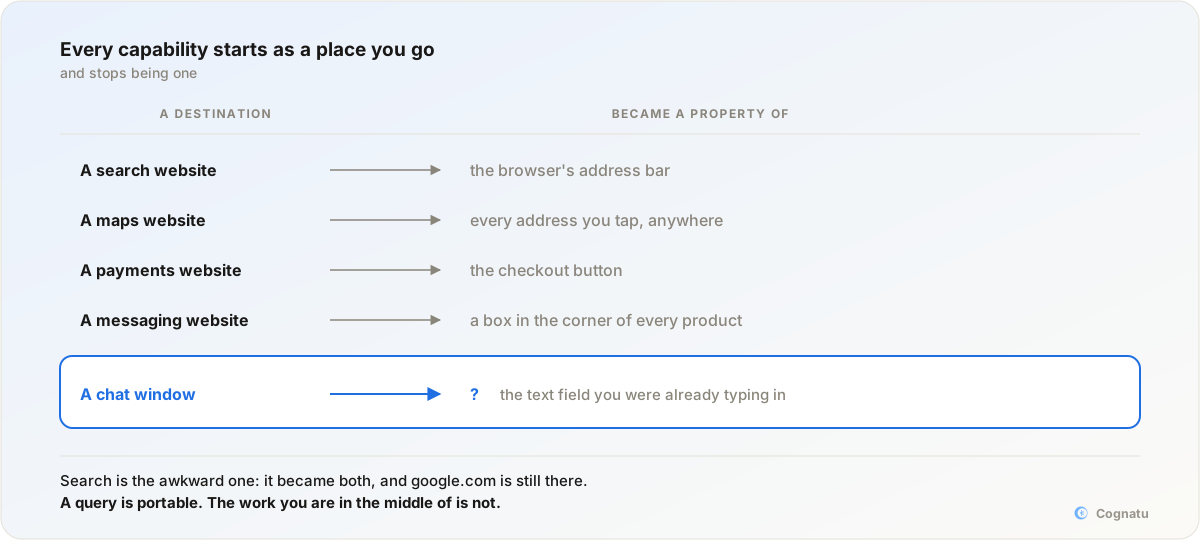
Which raises the obvious objection. Google.com is still there, and it is one of the most valuable destinations ever built. So why would a chat window be different?
Because search had a query: a small, portable unit of intent you can lift out of whatever you were doing and post somewhere else. That portability is why it could live in a box, and why the box could also be a website.
Work has no such unit. What you are stuck on is a half-written paragraph, a formula returning an error, a clause you do not understand. None of it detaches cleanly. Pasting into a chat window is carrying it by hand.
Chat is a destination
Every switch costs you the context you were holding. Writing an email, so you open an assistant. Stuck in a spreadsheet, so you switch tabs. Copy, paste, re-explain. We have built systems that are extraordinarily good at understanding context, and then arranged matters so that the human being has to carry that context from one application to another by hand. Which is the part I find genuinely odd.
Chat is not going away. Nor should it. When the task genuinely is a conversation, a chat window is the right shape. But most work is not a conversation. It is a document, a cell, a message, a form. Asking is the wrong verb for those.
The keyboard is the richest surface nobody uses
One interface already exists inside almost everything. Mail, messages, documents, code, the box you type a support ticket into at eleven at night when something has broken and you cannot quite describe what. The keyboard is where ideas turn into actions, and it happens to be where the context is thickest.
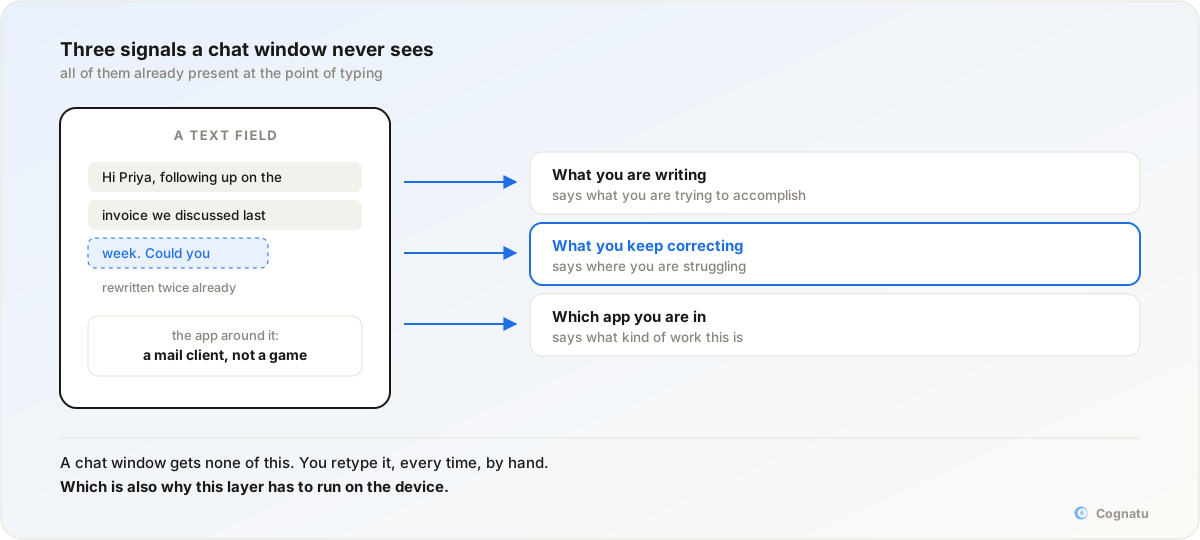
Three signals sit there for free. What you are writing says what you are trying to accomplish. Which app you are in says what kind of work this is. And what you keep correcting, going back over the same clause a third time, says where you are actually struggling.
The middle one keeps pulling at me. A chat window sees your finished question, tidied up before you press send. A text field sees the three attempts before it. That is a better signal about what you actually need, and it is thrown away every time.
I went looking for how much of this already exists and found more than I expected. Apple's Writing Tools already run inside standard system text views, in any app, with no work from the developer1, and the on-device model behind Apple Intelligence is now exposed to developers directly2. Android has the same shape: Gemini Nano through AICore, reachable by apps via ML Kit for summarising, proofreading and rewriting, input and output staying on the device34. The plumbing is shipped. What is missing is anything worth using on top of it.
The smartphone built an economy around apps. Skills could build the next one. Not an AI Writing Assistant, but explain this and find the mistake, working the same in your mail as in your editor. The model turns into plumbing. The skill is what anyone would actually pay for.
Which changes who wins
AI companies compete on models, and those differences are narrowing. That was the last post: as intelligence gets cheap, the scarce thing moves. For advertisers that means intent. For platforms, distribution. Whoever puts something useful into the most moments of your day beats whoever has the best model sitting behind a window, waiting to be opened. Operating systems, browsers and keyboards never have to persuade you to open anything.
Which should worry you, including about us. Whoever owns the text field can read everything you write, including the two versions you deleted, and the correction signal that makes this layer useful is precisely the one that makes it dangerous. Same signal. Both directions. Not an argument for retreating to chat. It argues that the layer has to run on the device and stay open, which is where the vault post ended up from the other side. On-device does not settle it either. It narrows the problem. It does not delete it.
Get that wrong and we will have built the most intimate surveillance surface ever shipped, one helpful suggestion at a time.
The next interface
We stopped saying "going online" at some point and just used things that happened to be connected. Nobody announced it. The AI experience that wins may not have the biggest chat window. It may not have one at all.
The chatbot taught us that machines can understand us. The next thing to learn is that they should not have to wait to be asked.
See what leaves the device
Our demo runs a real conversation, works out what it is about, and matches an ad without the text ever leaving the machine. Open your network tab and watch what crosses. That is the same constraint this post is asking of the keyboard layer. No account needed.
Watch it run Or read how the SDK works →Next: The Token Is the New Bandwidth. Why intelligence getting cheap moves the money somewhere else.
Sources
- Apple Developer, Writing Tools. Standard UIKit text views get Writing Tools with no code from the developer; custom views adopt it through
UIWritingToolsCoordinator. - Apple Developer, Foundation Models framework. Direct access to the on-device model behind Apple Intelligence, offline, with nothing sent off the device.
- Android Developers, Gemini Nano. Runs through AICore, the system service that executes the model locally.
- Google, ML Kit GenAI APIs. Summarisation, proofreading, rewriting and image description on-device; input, inference and output never leave the machine.
Cognatu builds privacy-first infrastructure for AI apps · cognatu.com